Sunday, February 26, 2006

Conversation at the Table


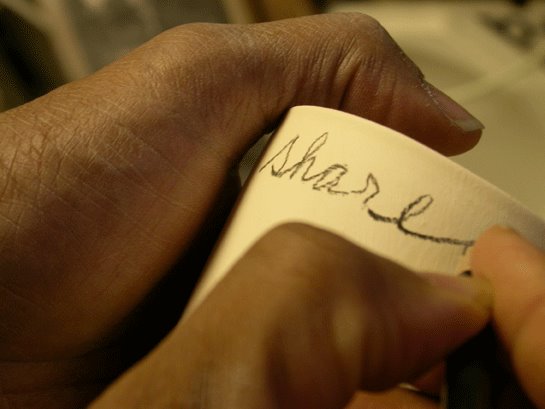
Yesterday, Lonnie Graham visited the studio and we glazed 60 cups for his project "Conversation at the Table". It will be held April 7th in Philadelphia. We wrote the words share, serve, and heal on each cup and glazed them. They will be fired tomorrow. I will post his idea when he sends me the proposal. His work is about people, stories and solutions. It is a priviledge to work with an artist with whom I resonate so profoundly. It was a good day...

technorati tags: , , , , , , , ,

art esprit

art esprit

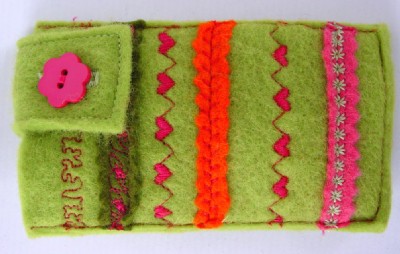
Very fun blog. Great iPod Nano case. I love felt...
http://photos1.blogger.com/blogger/5362/1858/1600/get_jpg_detail_image.php.jpg

Friday, February 24, 2006

International Day of Peace


united nations, originally uploaded by novon.

I went to the UN yesterday to meet with a die hard group of peace niks organizing for this year's International Day of Peace (IDP). The UN established September 21st as the IDP in 2001, after 9/11. A resolution to designate an IDP was passed in 1981, but September 21st wasn't chosen until 5 years ago.

There's a lot to do to get the word out, so any help I can get would be appreciated. Maybe September 21st could be dedicated to peace in blogsphere? Will you help me build the momentum? Aren't we sick of armed combat? It's the biggy, world peace, peace on earth. How about giving it a shot. Really living the change we seek. Can world peace be a reality, in our life time? Call me naive, but I think so.

Tuesday, February 21, 2006

Making fine porcelain


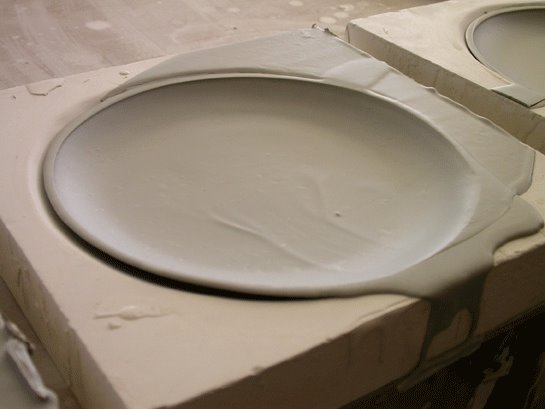
Here are some molds draining after being cast yesterday. 5 saucers at a time. The molds are made out of plaster, from my original shapes. After they drain, they are set on wire shelves to harden further until I can remove them from the molds to trim them. It was cold outside, but warm in the studio. Perfect for casting.


This is what the a plate looks like after it comes down from the drying rack, ready to trim. The trimmed clay goes into a bucket for reclaim.


tags: , ,

Monday, February 20, 2006

Arts and Crafts


Udon Bowls, originally uploaded by madpotter1.

It seems we are living in an all or nothing world. Since my focus here is on production and handmade stuff, I'm going to address that statement vis a vis look at how our stuff comes into being. A lot of stuff in the world, the intimate items of everyday use, are produced in factories whose main objective is to maximise producation and reduce dollar cost. This approach has lead to a vast network of factories, delivery systems and distributors whose objective is also to maximise output while reducing cost with an eye on profit. In and of itself these are fine objectives. But, as the world has gotten bigger (or smaller) the means of production by large scale industrial factories ceases to be an affective tool to eradicate poverty and hunger, for the many. Industrial factories often seek to reduce human labor, as in the pin factory model of Adam Smith. Separating steps of production to be performed in a rote fashion has reduced the cost of production, in the short run. But the long term implications of this model are waning in their affectiveness.

What of the role of craft and the master craftsman (woman)? I argue that craft enhances our lives, all the more so in an age where anything is accesable and our wants are being placed above our needs. Craft gives us greater choice, flexibility and empowers us to create lives of greater meaning. Choosing small scale craft producers goods in a time of over production of mass marketed objects allows the freedom to buy things that build a home full of items of individual taste. If freedom is the big thing these days, why not express that through buying handmade stuff? Curate your home.


Friday, February 17, 2006

Small is Beautiful

http://www.swedetrack.com/images/schum.jpgE. F. Schumacher wrote the classic, Small is Beautiful, which became very influential in the 70's and has been recognized as one of the 100 most influential books written since World War 2. A British economist, Schumacher evangelized the notion of intermediate technology and small, human scaled production throughout his esteemed career.

Small is beautiful is a collection of essays about economic develoment of a different sort than what the conventioanal wisdom suggests. Decentralized, moderate sized production is the hall mark of Schumacher's vision. He suggetsts that production has not been solved by huge mass producing factories, and in fact these very factories, by their reliance on overly large and sophisticated machinery can squash a local eceomy. Over developed focus on perfection and inexpensive products and labor steals the soul out of making.

We live in a time where production can be readjusted to fit a more human need for just and sustainable making. Even in a highly developed nation like the US, making and production can be refitted to be more appropriate for human consumption. Expecting a perfect, cheap and fast product may not be what we want anymore, as Seth points out today. Buying handmade goods from artisans, or adding the task of making in each of our days, may lead us to a gentler way of living on this great orb. Taking greater care in choosing what we live with by focusing on handmade artisanal objects when want something could change the energy in our home. Shifting away from the overly perfect, mass produced goods that pollute our homes might just enhance our home environments. Can you imagine living with objects created by someone, a human being who loves what they do? Who we might know or may have met? I think this would change the dynamic of the home. Home is where the heart is.

This may seem like an expensive alternative, but I argue that while small is beautiful, less is more. Fewer things, created often imperfectly, are what I choose to use and live with. Saving up for a special object that will be cherished for a lifetime (or at least more than 5 minutes) gives me greater satisfaction than getting a quick hit from something easy, cheap and ad hoc.

links: E. F. Schumacher Society
Resurgence Magazine
tags:

Tuesday, February 14, 2006

Happy Valentine's Day!

Conventional Wisdom

There is a lot of fear being sold in the press. That’s right, being sold. Fear sells newspapers. Even the weather channel has created a sensational “spin”, weather as fear inducer. Fear is fun. Fear is exciting. It gets my adrenaline pumping. But, why are we so afraid? Seth Godin makes the point yesterday re. parody. Digging into facts and what is real takes time. Effort.

It is possible now more than ever for people to prosper. Poverty continues to be a problem, but it isn’t a new problem. It is an OLD problem. In fact, a lot more of us used to be a lot poorer. When kings, queens, pharaohs, etc. owned slaves by the 1000’s, they had all the wealth created by the labor of the many. Today, it is more likely we can create wealth or at least a decent living through our own labor. We must give a slice to the government in taxes, hopefully for roads, schools, health care and long term social security. Unfortunately a big chunk goes into military spending, which is bolstered by fear, these days, of terrorists.

But, the military has always gotten the lions share. We allow that because we are afraid. Afraid we will lose all that we have. How much fear is irrational? I argue a lot. Being swept up into a popular mindset is easy, in the short run. Thinking on our own, discerning fact from fiction takes work. It takes work to differentiate the “news” driven by a media with the need to sell papers and air time with high overheads, fearful themselves of not making enough money to cover their costs. So, they spin. Solutions are all about work. It takes work to find ways of being that inspire peaceful exchanges. Making our own goods, trading and selling them ourselves to our neighbors, fairly and because what we produce is of value, that is a lot of work. Finding out what is true, takes work. It takes digging. Being skeptical of sensation, where’s the fun in that?! Sensation is such a hit. Skeptics are such sticks in the mud! There’s a high in believing what a lot of others believe.

Conventional wisdom is anything but. It is conventional, but it is not wise. Authentic stories, truth, is often unpopular because it destroys long held beliefs. Changing our perspective, our minds about reality as we have come to know it can be painful. The fact that the earth revolves around the sun and not the other way around landed Copernicus in deep dudu. The flat earth concept lived for centuries after Columbus landed in America, not mention all the others who had found the earth to be round well before him. Conventional wisdom is difficult to shift. People want to believe the sky is falling.
Sunday, February 12, 2006

Photo shoot

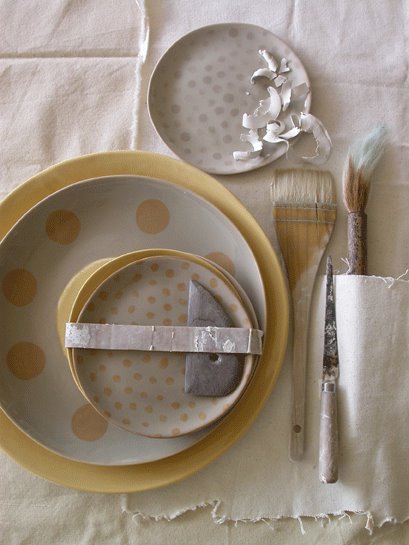
Yesterday the fabulous Sibella Court joined me and Dan Perlmutter in my studio for a photo shoot of my spring/summer collection. With an eye toward telling the story of handmade, in my studio, one at a time, Sibella dug around my work space and used brushes, tools and scraps of clay to help a picture tell 1000 words. How'd we do?? Thank you, Sibella and Dan! It takes a village...

Saturday, February 11, 2006

Meaning

This image is my kiln, too hot to unload yet, open this morning. New plates.

I operate from the premise that all art functions. It inspires, it questions, it teaches, and it can also serve a mundane purpose. The daily use of items in the home, created as works of art actually takes art to the next level. Conventional wisdom sees art as a seperate thing from life. Something so precious and valuable that it lives in museums, untouchable and beyond reproach. But, in fact, those are deadly assumptions. Living with art, using art, gives us all more to live for on a daily basis. Being inspired, moved and enlivened gives everyone a greater sense of meaning in our lives. Hugh MacLeod says there's an infinate market for meaning. Does that mean we will make a lot of money if we create meaningful work for a meaning starved audience? Maybe, but I don't think it is that simple. Meaning isn't something that can be created, packaged and sold by the billions. Meaning is built, one day at a time, by creative thoughtful people doing and producing meaningful work. I believe there are piles of people doing this. I like to call them artists because that word still has meaning for me. If everyone were to take heed and support the artists of the world, I think we stand a chance. If we buy the things made by the people we meet, our friends and neighbors, working in studios and workshops peppered across the countryside, be it in New Englad or New Zealand and all points in betweeen, that is how the revoltution (evolution?) will quietly take place.

We all have choices about how we live. The more deeply we understand how our choices affect ourselves and eachother, then a more a just world comes into focus.

Friday, February 10, 2006

Whip up

whipup
A new, totally cool blog about all things craft. Are there any potters blogging and linking? Thanks to design*sponge for the tip.